
 Identify
Security problems are identified before they can cause disruption to your business.
 Secure
Endpoint Protection offers you these distinct advantages of 24/7 protection for all of your endpoint devices.
 Manage
With around the clock fault and incident management, your business is in safe hands.
Request a Call from Sales
Complete Managed Endpoint Security Service
Modern businesses are reliant on their IT systems and are in need of round-the-clock support. Here at ExterNetworks, Managed Endpoint Security Services, we can protect all of your devices and operating systems to ensure no entry point to your network is left unprotected.
In an age where businesses are exposed to cyber threats, our SOC services at Externetworks are designed to protect all of your devices and operating systems with the same level of functionality, whether your operations are in the United States, across Europe, or anywhere around the world.

Detecting Signs of Endpoint Compromise
Protecting your business from harm before trouble happens.

Round the Clock Security
Security and data incidents are resolved quickly with our rapid response team.

Patch Upgrades
Timely and effective maintenance to ensure minimal network disruption.

Strengthen Security
Protection from the latest cyber threats.

Compliance
Stay up to date and in security compliance as per your standards

Increased Confidence
Peace of mind that your systems are protected.
What our Experts Can Do For You
Our security analysts will monitor and manage your Endpoint Protection 24/7, and will send you regular reports of threat and attack activity. Using our leading Endpoint Protection technology, we will also identify, manage, and respond to any security alerts, and will provide triage in response to any security alerts and threats. We will build a unique relationship with you so as to help you manage all of your operations.
Request a Call from Sales
Need Help? We're Here for Enterprises
ExterNetworks provides a broad range of enterprise-grade Managed IT Services designed for organizations of all sizes.
Our team of highly qualified and trained professionals is always ready to assist you around the clock with guaranteed SLA performance.
Request a Quote
Our NOC specialists help you in getting the right enterprise solution for your business within your budget. Fill the form & Get the best enterprise quotes with guaranteed SLAs.
Request a QuoteSchedule a Demo
Some enterprise stories are better if shown than told! Request a free demo to experience how ExterNetworks enterprise-grade Managed IT services can benefit your large enterprise. Schedule a Demo Today!
Request a DemoContact Sales
Have Questions about our managed NOC Services? Fill out the form, and our enterprise experts are ready to offer 24/7 support with guaranteed SLAs. Call Us Today!
 SALES: (732) 624-1900
Resources
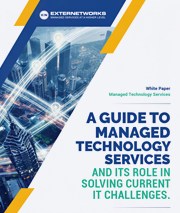
White Paper
A Guide to Managed Technology Services and its Role in Solving Current IT Challenges.
DOWNLOAD NOW!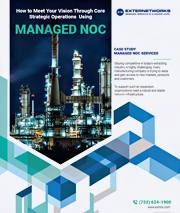
Case Study
How to Meet Your Vision Through Core Strategic Operations Using Managed NOC
DOWNLOAD NOW!You Asked. We Answered.
But if we didn't, just reach out to us and we'll be happy to answer your questions.
Contact UsFAQ's
Managed Endpoint Security is a fully outsourced service that protects all endpoint devices—such as laptops, desktops, servers, and mobile devices—from cyber threats. A managed service provider deploys advanced security tools, continuously monitors endpoint activity, detects threats, and responds to incidents in real time. This ensures your business endpoints remain secure without requiring internal security expertise.
Managed Endpoint Security works by installing security agents on endpoint devices that continuously monitor system behavior, network activity, and potential threats. These agents send data to a centralized management platform where security experts analyze alerts, detect anomalies, and take immediate action to contain or eliminate threats. This proactive approach helps prevent breaches before they impact business operations.
Managed Endpoint Security covers all devices connected to your business network, including desktops, laptops, servers, virtual machines, mobile devices, and remote employee systems. It also protects endpoints across on-premises, cloud, and hybrid environments. This ensures complete visibility and protection regardless of where your users or devices are located.
Key features typically include:
- Real-time threat detection and prevention
- Antivirus, anti-malware, and ransomware protection
- Endpoint Detection and Response (EDR) capabilities
- Continuous monitoring and incident response
- Automated patch management and vulnerability remediation
- Device control and policy enforcement
- Centralized management and reporting dashboard
These features help businesses maintain strong endpoint protection while reducing operational risks.
Before selecting a provider, businesses should ask:
- Do you provide 24/7 monitoring and incident response?
- What endpoint protection technologies do you use (EPP, EDR, XDR)?
- How quickly do you detect and respond to threats?
- Do you support remote, cloud, and hybrid environments?
- Can you provide detailed security reporting and compliance support?
- How do you handle zero-day and advanced persistent threats?
These questions help ensure the provider can meet your organization’s security and compliance requirements.
Endpoint Protection Platform (EPP) focuses on preventing known threats using antivirus, firewalls, and signature-based detection. Endpoint Detection and Response (EDR) goes further by continuously monitoring endpoint activity, detecting advanced and unknown threats, and enabling rapid investigation and response. EPP provides prevention, while EDR provides deep visibility and active threat response.
Endpoint security detects zero-day threats through behavioral analysis, machine learning, and threat intelligence, rather than relying solely on known signatures. It identifies unusual activity, such as abnormal processes or unauthorized access attempts, and triggers alerts for immediate response. This proactive detection helps stop unknown threats before they cause damage.
ExterNetworks delivers enterprise-grade endpoint protection backed by 24/7 monitoring, advanced EDR technologies, and expert security management. Our managed endpoint service ensures proactive threat detection, rapid incident response, and continuous compliance support. This allows businesses to reduce security risks, improve endpoint visibility, and focus on core operations while maintaining strong cybersecurity protection.
Managed Endpoint Security helps multi-location enterprises maintain consistent security policies and endpoint visibility across geographically distributed offices, remote employees, and branch locations. A centralized management platform lets security teams monitor endpoint activity, identify threats, and coordinate incident response across environments. This helps organizations enforce consistent protection policies while reducing the complexity of managing security independently at each location.
Yes. Managed Endpoint Security solutions can integrate with existing Security Information and Event Management (SIEM) platforms and Security Operations Center (SOC) workflows, depending on the available technologies and integration capabilities. Endpoint security alerts, threat intelligence, and incident data can be shared with centralized security platforms to improve threat correlation, investigation, and response coordination. This integration helps enterprises strengthen security visibility without necessarily replacing their existing security infrastructure.
Managed Endpoint Security pricing typically depends on the number of protected endpoints, selected security technologies, monitoring requirements, incident response coverage, and service-level agreements. Additional factors may include deployment complexity, integration with existing security tools, reporting requirements, and support for geographically distributed environments. Enterprises should evaluate the overall service scope and coverage rather than comparing providers solely on per-device pricing.
Enterprises should evaluate service-level agreements (SLAs) covering monitoring availability, security alert acknowledgment, incident escalation, response coordination, reporting frequency, and service support. The SLA should clearly define responsibilities, severity classifications, escalation procedures, communication channels, and service performance measurements. Organizations should also distinguish between timelines for alert acknowledgment, investigation, containment, and remediation when evaluating provider commitments.
Enterprises can transition to Managed Endpoint Security through a phased deployment that begins with endpoint discovery, security assessment, and existing tool evaluation. The provider then establishes deployment priorities, configures endpoint protection policies, tests integrations, and validates monitoring capabilities before expanding coverage across the organization. A controlled rollout, coordinated change management, and defined escalation procedures help minimize operational disruption while maintaining endpoint visibility throughout the transition.